|
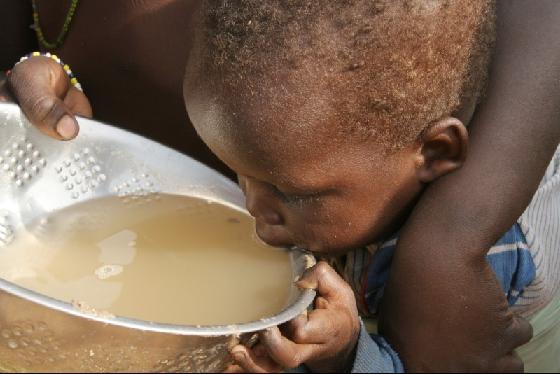
| Person drinking contaminated water |
More than 3.4 million people in this world die every year from issues relating to water, sanitation, and hygiene. Of these 3.4 million people, 99% of them occur in the developing world. According to the United Nations, unclean water kills more people than war combined with all other forms of violence. Because water sustains life, it is life’s most basic need, yet many people in the world are unable to have access to this necessity.
 |
| Child drinking unclean water |
Many parts of a person are affected by unclean water. Unclean water can cause children to be unable to attend school and parents to be unable to maintain a job. Drinking water gives humans energy to perform their daily functions. If a person gets sick from drinking contaminated water, they are unable to go about their daily tasks. Children are unable to go to school, and parents are unable to work for money. Most of all, drinking unclean water can cause numerous health problems and diseases. According to Water Projects International, 80% of all disease in the world originated from unclean water, poor sanitation, or bad hygiene. Water and sanitation directly links to the health of each and every person. Drinking unclean can cause a person to get Typhoid fever, also called Salmonella Typhi. Typhoid fever can cause birth defects, cancer, and generic damage. From drinking polluted water you can also get Cholera. Cholera affects a person’s intestines. Without immediate medical treatment, a person affect by Cholera could die within 12 hours. A person can also get Trachoma from drinking unclean water. Trachoma irritates the eyes and can cause blindness. Unclean water can also cause a person to get amoebic dysentery. It is an intestine infection that causes severe diarrhea. Schistosomiasis is a disease that is caused by parasitic worms. A person gets infected when their skin comes in contact with contaminated freshwater, where harmful snails live. Crops need clean water to grow. Without clean water for irrigation, crops die, providing families with little to no food to consume.
 |
| Children gathering water from a local stream |
The UN estimates that Sub-Saharan Africa spends 40 billion hours a year gathering water. That wastes a lot of time. A jerry can, the typical container used to gather water in Africa, weighs over 40 pounds when it is completely full. Children have to walk many miles to an unclean water source to collect water, when instead, they could be going to school. Malalatiana Rosoanisina from Madagascar said, “Twice a I’d have to collect water, it gave me stomach ache as the water was yellow. I couldn't go to school and had to go to the doctor.” Malalatiana would often get sick from drinking dirty water and would have to skip school. Additionally, Malalatiana had to collect water from an unsafe spring. The path leading to that spring was dangerous and slippery. She often fell over and lost water. As a result, she was forced to return to the spring to collect more water for her family. Shilpi Mondal from Bangladesh told the organization WaterAid about her situation, “We collect water from 20-30 km away, usually about once every ten days. We share a boat with our neighbors as we can’t afford our own. This water gives us diarrhea – we know it does – but what else can we do – we have no choice. When I give the water to my daughter I know it will make her ill. It makes me very sad.”
 |
| African children using LifeStraws, a portable water filter |
 |
| Clean water |
Many organizations are helping out with this global issue. Such organizations include Water.org, Water Projects International, Blue Planet Network, and Concern Worldwide. These organizations work together with the affected countries to build wells and other water structures. It significantly improves access to water for people, therefore, saving time. WaterisLife.com provides areas with unclean water with water filters, a water filter system for households, and clean water wells. Many organizations are doing their best to tackle this global issue as effectively as they can. However, they can always use help from you!
Ending poverty begins with clean water. Unclean water causes poor health, hunger, and a lack of education. These three things lead to a cycle of poverty.
Deuteronomy 15:11 - There will always be poor people in the land. Therefore I command you to be openhanded toward your fellow Israelites who are poor and needy in your land.
Sites Used:
 On October 11, 2014, I went to the Tai Po Organic Farm again. This time, the work we did was not as tiring compared to last time. A volunteer started us off by giving us a tour of the farm. He introduced us to the nursery and the different plots in the organic farm.
 As I have said before, I really enjoy going to the Organic Farm. I can integrate a lot of symbolism in it. In order for our faith to grow, we need to have sufficient "nutrients". Those "nutrients" would include spending time with God and reading the Bible. I should continue to develop my faith.